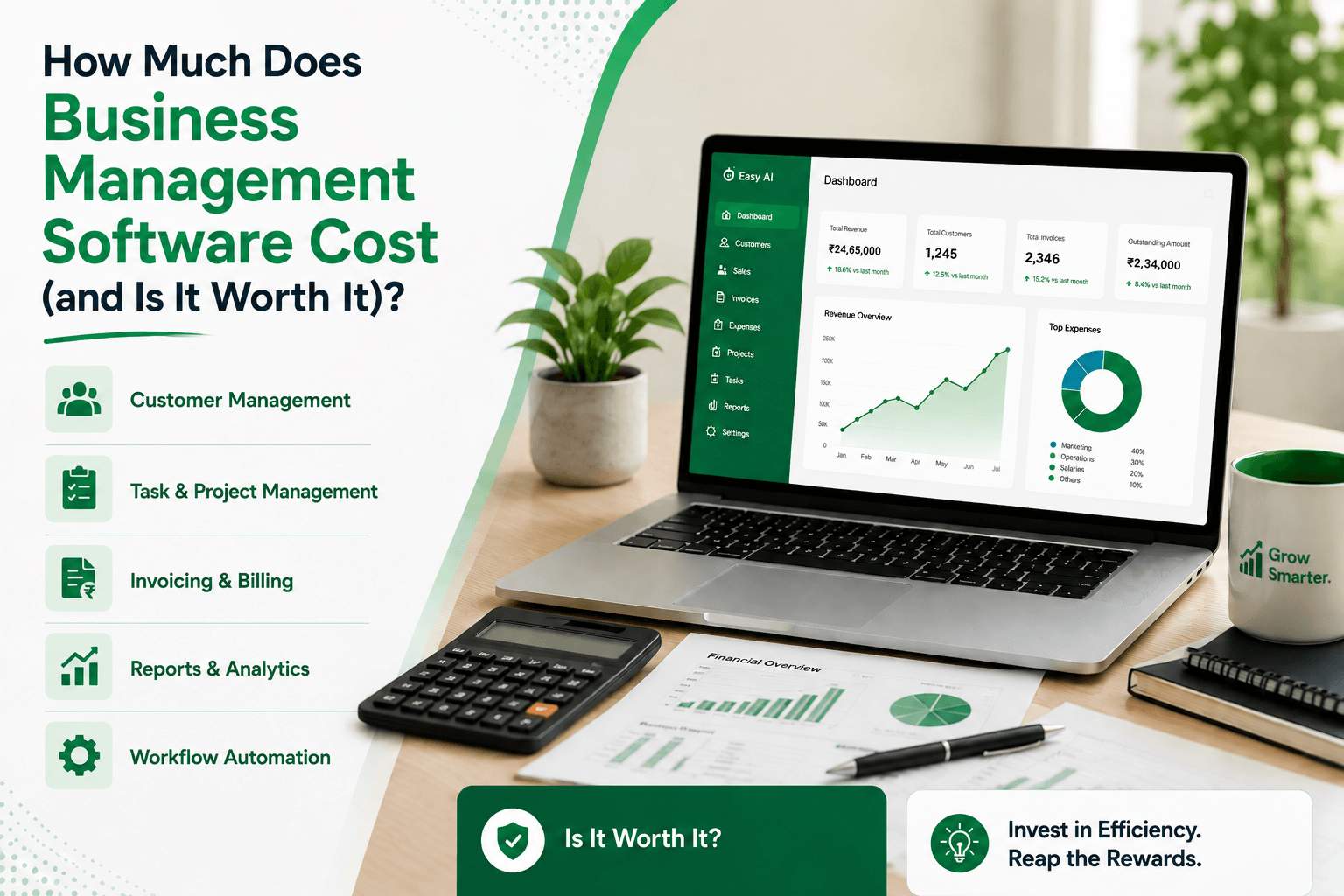
As businesses grow, managing operations through spreadsheets, WhatsApp chats, manual follow-ups, and disconnected tools often becomes inefficient, time-consuming, and difficult to scale. Missed follow-ups, delayed invoices, poor team coordination, and operational confusion can slowly begin affecting customer experience, productivity, and profitability.
That's why more businesses are adopting business management software to manage operations, teams, customers, and finances from one centralised system.
But before making the investment, most business owners want to know:
How much does business management software cost, and is it worth it in the long run?
Business management software is an all-in-one platform that helps businesses manage daily operations, teams, customers, finances, and workflows from a single dashboard.
These platforms typically combine multiple business functions, such as:
Instead of managing multiple disconnected tools, businesses can centralize operations through one integrated platform.
As businesses grow, managing operations manually often creates workflow bottlenecks, communication gaps, delayed follow-ups, and reduced operational visibility.
Business management platforms help businesses improve areas such as:
WhatsApp messages have a 95% read rate, compared to ~30% for email, improving communication reliability. This means reminders, follow-ups, appointment confirmations, and promotional offers are more likely to reach customers through the channel they actively engage with.
Around 63% of customer leads come in after business hours, which are often missed in the manual systems.
Modern business software now includes AI-powered automation tools like Easy AI, helping businesses automate repetitive tasks, respond faster, and reduce manual workload.
Businesses that adopt centralised management systems and workflow automation tools often improve response times, operational visibility, and cross-team coordination compared to businesses still relying heavily on manual processes.
For example:
A salon can automate appointments, billing, and customer reminders.
A clinic can manage patient records, prescriptions, and follow-ups from one system.
A retail business can monitor inventory and sales in real time.
Without organised systems in place, businesses often struggle with delayed communication, inconsistent customer follow-ups, billing errors, and inefficient workflows, all of which can gradually reduce customer satisfaction and limit business growth.
Many businesses assume management software is expensive, but modern cloud-based systems are often more affordable than the long-term cost of operational inefficiency. Software pricing ultimately depends on the scale, goals, and operational needs of the business.
A small startup may only need basic tools for client management, appointment scheduling, and invoicing, while a larger business may require advanced automation, analytics, and integrations across the distinct departments.
Instead of focusing only on the question, 'How much does the software cost?' Businesses should also ask:
This shift in mindset helps businesses to view the software as a long-term investment that supports smoother operations for better decision-making and future growth.
Business management software pricing can vary significantly depending on the size of the business, required features, number of users, customisation needs, and industry-specific requirements. Smaller businesses may only require the essential tools for customer management and billing, while larger organisations often need advanced automation, analytics, integrations, and multi-department operational systems.
Because every business has unique workflows and requirements, most software providers offer flexible pricing tailored to operational needs and scalability, rather than a one-size-fits-all package. Smaller businesses often choose affordable monthly subscription plans, while larger organisations may invest in advanced systems with custom workflows, integrations, and automation features.
This is why the real focus should not only be on software cost but also on the operational value and long-term efficiency it delivers.
Several factors influence the final amount spent on management software.
1. Features and Functionality
Basic software plans are usually more affordable because they offer limited features and functionality. Advanced platforms with automation, AI tools, analytics, and integrations usually cost more.
2. Number of Users
Most software providers charge based on the number of users who need access. Growing workforces usually face increasing subscription costs over time.
3. Customization Requirements
Businesses with unique workflows may require custom dashboards, integrations, or reports.
4. Cloud-Based vs. On-Premise Software
Cloud-based software is easier to maintain, update, and scale compared to locally hosted systems.
5. Sector-Specific Needs
Sectors like healthcare, production, logistics, and finance frequently require specialised compliance and reporting features, which can elevate the pricing.
Many organisations zero in on the subscription fee and overlook additional operational costs. Inefficient customer acquisition can cost significantly more than automation-based referral systems.
Common hidden costs include:
Without the proper forward planning, these hidden costs can erode the overall return on investment.
Not always.
One of the most common mistakes businesses make is investing in overly complex software filled with features their teams rarely use. The best software is not always the one with the most features, but the one that solves operational problems effectively and is easy for teams to use consistently.
The right software solution should:
Simpler cloud-based software solutions can provide outstanding results without needless complexity for a large number of small and medium-sized businesses.
The real value of business management software lies in simplifying daily operations, reducing manual work, and helping businesses scale more efficiently.
Businesses using the right software often experience:
Referral customers typically have higher lifetime value compared to paid acquisition customers. Automation helps employees spend less time on repetitive tasks and more time focusing on customer service, sales, and business growth. In many cases, referral clients can cost as little as ₹500 to acquire compared to ₹2,000 or more through paid social media advertising. By improving customer retention, follow-ups, and referral generation, business management software can often pay for itself through recovered and retained clients alone.
Over time, these enhancements can translate into:
Before investing in software, businesses should carefully evaluate their operational needs and long-term goals.
Identify Your Biggest Operational Challenges
Identify where your business experiences the biggest delays, inefficiencies, or communication gaps. The right software should directly solve those operational bottlenecks.
Think About Future Scalability
Choose software that can scale with your business instead of finding a replacement as your operations grow.
Choose Software That Your Team Can Easily Adopt
If staff members find the platform difficult to navigate, adoption rates will fall, regardless of how advanced the system is.
Check Integration Compatibility
Confirm the software can integrate with existing tools like payment gateways, email services, or sales platforms.
Use Free Trials and Product Demos
Testing software through free trials or demos helps businesses make more confident and cost-effective decisions. A personalised demo can also help business owners understand how the software fits their existing workflows before making a long-term commitment. Many businesses underestimate how much revenue and productivity are lost due to disconnected systems and manual processes.
Over time, even small operational delays can affect customer experience, employee efficiency, and overall profitability.
For most businesses, the answer is yes.
In many businesses, the long-term cost of missed follow-ups, delayed communication, manual errors, and inefficient workflows is often far greater than the software investment itself. Over time, these operational inefficiencies can reduce productivity, weaken customer experience, and impact overall profitability.
Business management software helps companies improve efficiency, gain better operational visibility, and make faster business decisions. When chosen carefully, it becomes a long-term growth asset rather than just another monthly expense.
Many businesses underestimate the long-term return on investment that management software can deliver. Saving employee time, reducing manual errors, improving customer retention, and streamlining operations often create far more value than the software cost itself.
Business management software is no longer just a convenience; it has become an essential growth tool for modern businesses. Modern AI-powered systems can further improve bookings, retention, and customer communication through automation tools like Easy AI.
While pricing depends on business size, features, and users, the real cost often comes from inefficient operations, missed opportunities, and manual processes that limit growth.
The right software helps businesses improve productivity, customer experience, team coordination, and decision-making through a single centralised platform.
When implemented strategically, business management software becomes a long-term operational asset that helps businesses improve efficiency, strengthen customer experience, increase productivity, and scale more confidently in an increasingly competitive market.
Ready to streamline your operations, improve customer management, and reduce manual work? Book a free demo with Get Easy Software and see how the platform can work with your business data in real time.

"Get Easy Software boosted our salon’s growth! WhatsApp integration is perfect."
@beauty01_hub

"One of the best POS systems ever! Automation saves us hours!"
@spa_lux_ury

"Client tracking and loyalty rewards are excellent and highly recommended."
@auto_care_first

"Perfectly integrated with our staff management and incredibly user-friendly."
@studio.89_glow

"Our repeat bookings increased by 40%! The campaigning tool is a game-changer."
@nail_chic_glow

"Customer support is always ready to provide truly exceptional service!"
@tattoo_ink.zone

"Perfect for managing multiple branches, everything is visible at a glance!"
@med_care99

"The analytics revealed our top-earning services, absolutely brilliant!"
@pet.hub_palace
"Get Easy Software boosted our salon’s growth! WhatsApp integration is perfect."
@beauty01_hub
"One of the best POS systems ever! Automation saves us hours!"
@spa_lux_ury
"Client tracking and loyalty rewards are excellent and highly recommended."
@auto_care_first
"Perfectly integrated with our staff management and incredibly user-friendly."
@studio.89_glow
"Our repeat bookings increased by 40%! The campaigning tool is a game-changer."
@nail_chic_glow
"Customer support is always ready to provide truly exceptional service!"
@tattoo_ink.zone
"Perfect for managing multiple branches, everything is visible at a glance!"
@med_care99
"The analytics revealed our top-earning services, absolutely brilliant!"
@pet.hub_palace

"Our bookings doubled once we started using their online scheduling system."
@glow07_getter

"Automated reminders significantly reduced our no-shows, great ROI!"
@autocore_car.spa

"At last, software that really gets what owners need."
@aesthetic_pro

"Secure, fast, and highly intuitive; patients love the experience!"
@clinic_care.flow

"Managing walk-ins and appointments has never been this easy!"
@barber_premium

"The integrated inventory management perfectly prevents stockouts."
@style_studio.uss

"Globally recognized as the most comprehensive platform for auto businesses."
@match_car_vibes

"A must-have for anyone wanting to modernize their daily operations."
@modern_beauty.tech
"Our bookings doubled once we started using their online scheduling system."
@glow07_getter
"Automated reminders significantly reduced our no-shows, great ROI!"
@autocore_car.spa
"At last, software that really gets what owners need."
@aesthetic_pro
"Secure, fast, and highly intuitive; patients love the experience!"
@clinic_care.flow
"Managing walk-ins and appointments has never been this easy!"
@barber_premium
"The integrated inventory management perfectly prevents stockouts."
@style_studio.uss
"Globally recognized as the most comprehensive platform for auto businesses."
@match_car_vibes
"A must-have for anyone wanting to modernize their daily operations."
@modern_beauty.tech

Makeup Hair and Academy

Studie’o 7

RED ORCHID HOSPITALITY PRIVATE LIMITED

NEEL DAVID SALON LOUNGE
Makeup Hair and Academy
Studie’o 7
RED ORCHID HOSPITALITY PRIVATE LIMITED
NEEL DAVID SALON LOUNGE
.png)
.png)
.png)
.png)
.png)
.png)
.png)
.png)
.png)